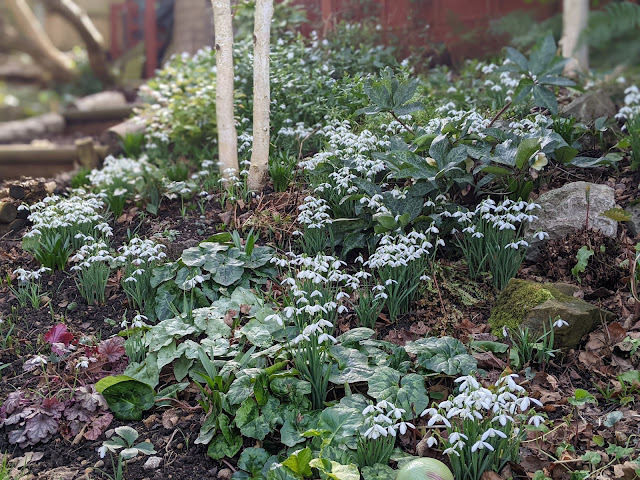
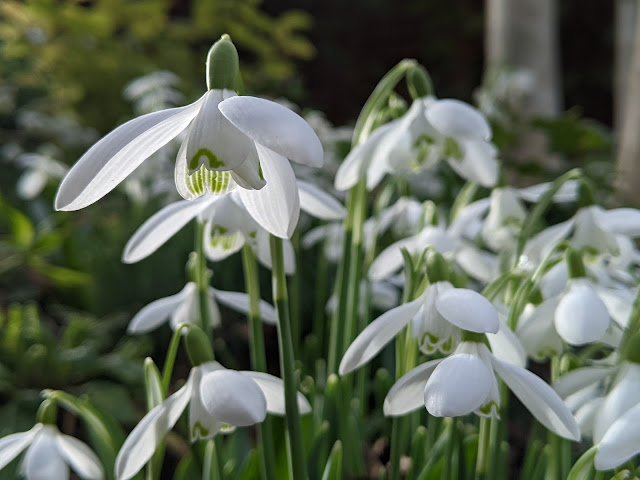
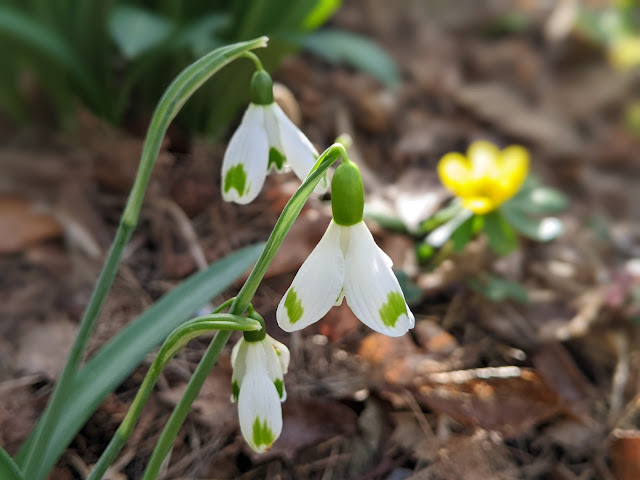
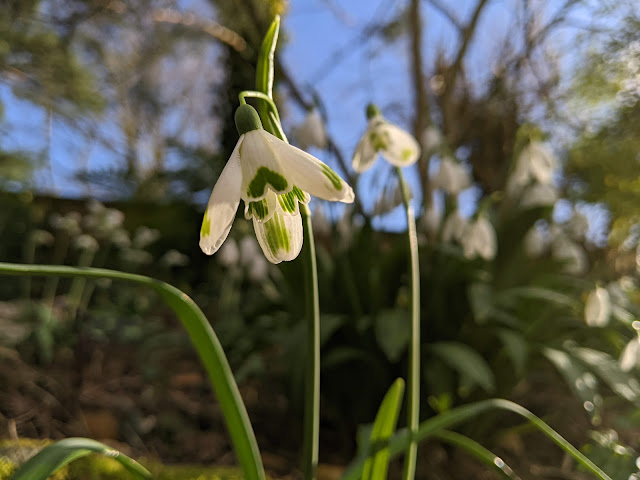
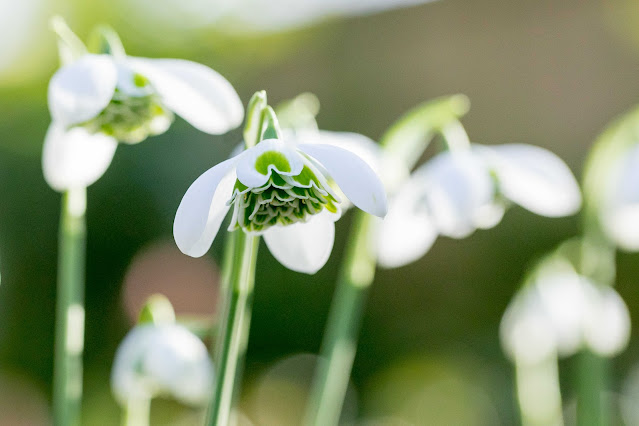
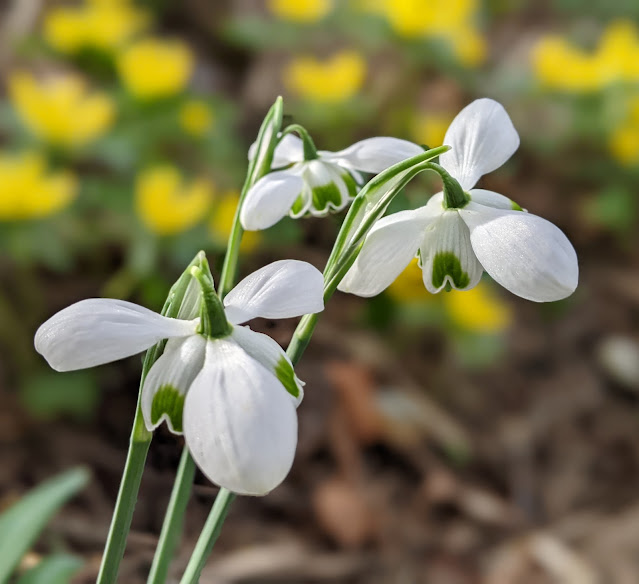
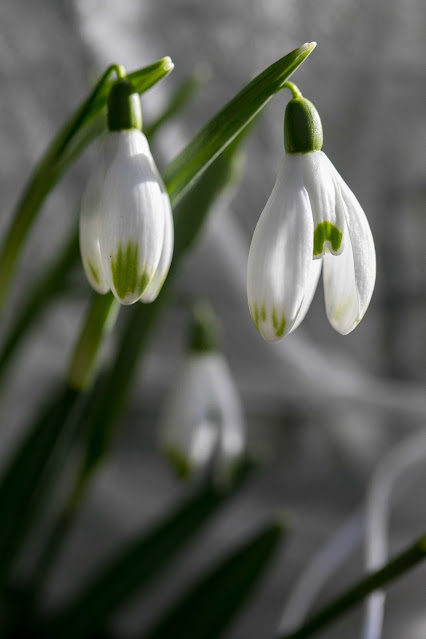
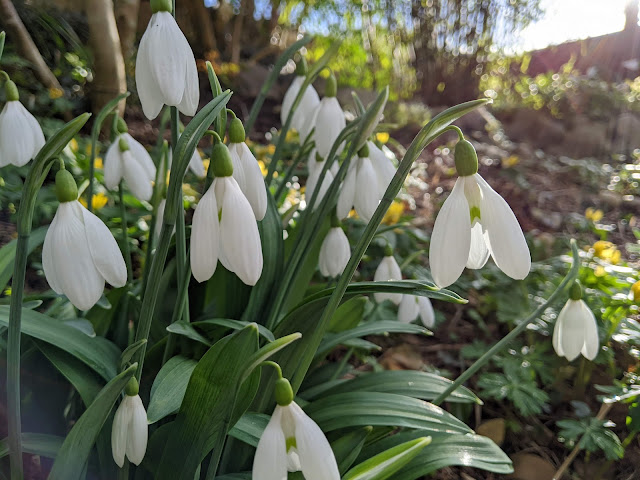
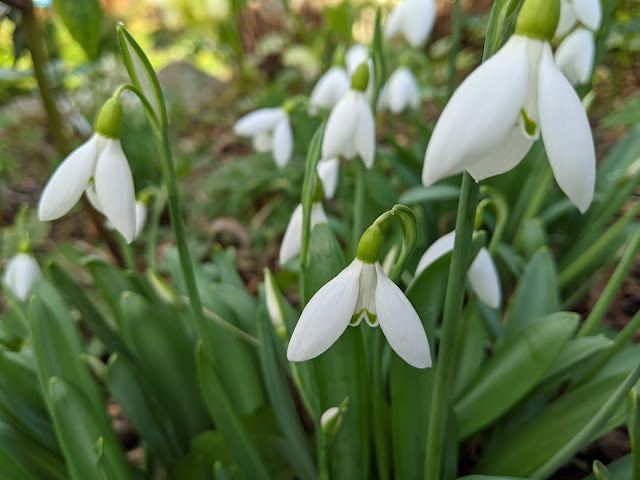
2020 appeared to begin just like any other year. The emergence of snowdrops heralded the start of a new growing season and the promise of the garden soon bursting into life. Even on dull days our ever-growing hellebore collection never failed to encourage us out into the garden and to lift our spirits. Soon they were joined by drifts of the cheerful yellow flowers of Eranthis hyemalis, the winter aconite.
 |
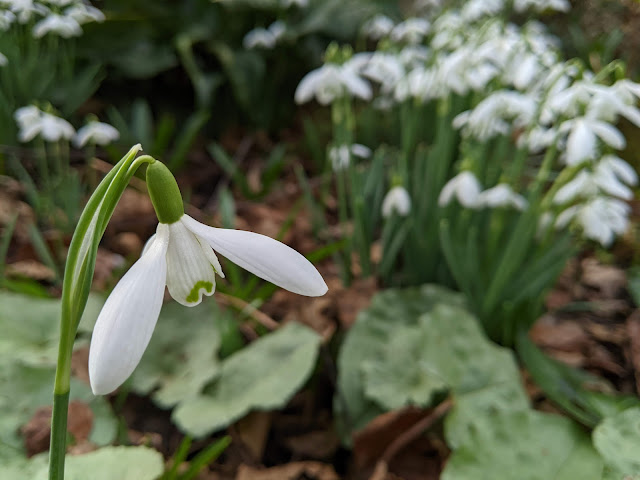
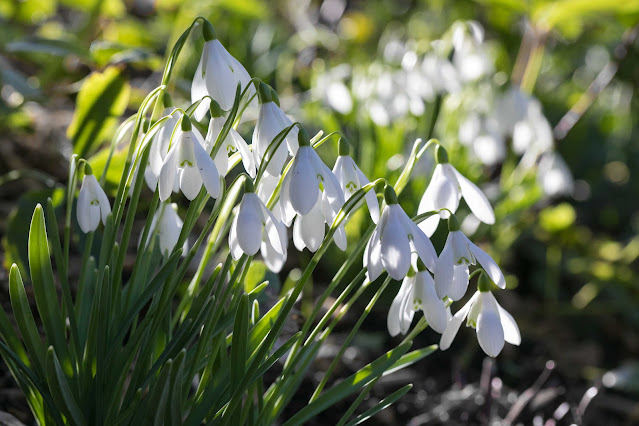
| Galanthus nivalis, the common snowdrop but easy and rewarding to grow |
I exhaled my annual sigh of relief as Arum italicum ‘Miss Janay Hall’ once again unfurled her striking, mottled leaves after several months of dormancy below ground. I am a Plant Heritage plant guardian for this little-known foliage plant, hoping to ensure that it does not get lost to cultivation and encouraging it to be grown more widely. So you can imagine my delight to see that she had not only increased in girth, but had produced a self-seeded baby. |
| Arum italicum 'Miss Janay Hall' |
But that was not the end of the surprises. In February 2020, we had the exciting addition of a Japanese TV film crew in the garden. We were one of six gardens chosen for a show about English gardens that open for the National Garden Scheme, raising funds for nursing and health charities including Macmillan Cancer Support and Marie Curie. Our first taste of filming was a real eye opener: I was amazed how long it took to film one shot, and how many different angles and lenses were needed.  |
| Pete being filmed pruning a red-stemmed cornus |
 |
Me being filmed performing my annual ritual of sponging
the birch trees to ensure that we can enjoy their white stems
|
Another day of shooting followed, along with preparations for a private visit of 30 gardening enthusiasts to view our early-flowering bulbs. That, of course, included baking cakes and scones, the essential accompaniment to any garden visit. |
| Hellebore and Fritillaria meleagris, the snake's head fritillary |
 |
| Chionodoxa |
 |
| Trillium kurabayashii |
 |
| Erythronium 'Pogoda' |
What came next we had not prepared for. On 23 March, three days after the official end of winter, the UK entered a national lockdown in an attempt to control the spread of COVID-19. The group visit was cancelled, and the TV filming was converted into twice weekly video diaries filmed on our mobile phones. Little did we realise how beneficial the shared tasks of planning, practicing and filming our gardening endeavours would become during a period when all our normal routines had suddenly disappeared.
The garden throughout that time was, and remains, our sanctuary and our source of comfort, exercise and motivation. We feel incredibly lucky to have the luxury of this private space. It is wonderful to see how many people have embraced a new-found interest in gardening, and in the joy of growing your own food, perhaps borne out of necessity but hopefully something that will continue.
 |
| A bench to relax and watch the fish swimming in the pond |
 |
| Our frog friends produced lots of frogspawn |
Our great culinary discovery was wild garlic, Allium ursinum. Planted years ago in our bluebell-filled woodland corner to remind us of the spring hedgerows which had enchanted us on a visit to the Channel Island of Sark. I had always intended to check its rampant spread by picking the leaves for cooking, but with the easy availability of shop-bought herbs I had failed to experiment. Faced with the challenges of obtaining fresh produce at the start of the pandemic we finally turned to the wild garlic - and what a revelation. Eaten raw the leaves have a mild, oniony taste. As an addition to Pete’s homemade burgers the flavour was mouthwatering. It became a year of many BBQs.
 |
| Allium ursinum |
 |
| One of many BBQs |
Spring brought plenty of warmth and sunshine. According to the Met Office it was the sunniest spring since records began 100 years ago. Our garden was lush and full of colour, but most of all it was brimming with bird song, made even more prominent by the almost total absence of urban noise.
The lockdown forced us to cancel our planned National Garden Scheme opening on bank holiday Monday 25th May, which would have been our seventh year of opening. It was sad not to share the garden and our passion about it with visitors, and we missed the camaraderie of our team of helpers – selling entrance tickets and plants, serving refreshments, and washing seemingly endless quantities of china cups and plates. But like many disappointments it gave rise to an opportunity for something new – to film a virtual opening instead. Much time was spent storyboarding, practicing and filming, and all our clips were wonderfully edited together by the National Garden Scheme team. We now have a lasting record available for all to see, presently viewed over 13,000 times on YouTube.

During the summer months we occupied ourselves working, mending and generally pottering outdoors, but more importantly just sitting and taking in the beauty of the plants, insects and birds around us. Climbing roses smothered with delicate blossom in June were followed by borders unashamedly full of bold and bright annuals and perennials: daylilies with deep red petals that could have been cut from a cloth of velvet, translucent crinkled poppies, and the scarlet trumpets of crocosmia.
 |
Rosa 'Wedding Day'
|
 |
Self-seeded annual poppies
|
 |
Oriental poppy
|
 |
Hemerocallis 'Cherokee Star'
|
 |
| Crocosmia 'Lucifer' |
 |
Our 'Hot bed', so-called because it's our sunniest bed, but also
because it's filled with vibrant-coloured flowers in summer |
The upside of having the garden to ourselves has been the
ability to make some major changes that would temporarily look unsightly. Pete made
valiant attempts to retrieve more lawn from the increasing spread of
wildflowers (I think perhaps in this instance we can more accurately call them
weeds). An old pittosporum that had lost its variegation but performed an
important role as a tall, green punctuation mark between beds was finally
replaced by what we hope will be an equally effective but more interesting Cryptomeria
japonica ‘Sekkan-Sugi’. And the steps in the woodland corner have been
re-routed closer to our beautiful white-stemmed birch trees, Betula utilis jacquemontii 'Doorenbos', offering a better
perspective of some interesting but often unnoticed plants chosen for their luminous
qualities in a dark corner – Galium odoratum, Fatsia japonica ‘Spider’s
web’, Vinca minor ‘Illumination’ and Geranium phaeum ‘Album’.
At the same time, we increased by a third the planting space in what we rather
grandly refer to as 'Hellebore Hill. Specimens which had been shoe-horned into
beds elsewhere in the garden have now been relocated so that we can look up
into their captivating flowers in late winter.
 |
| The re-routed woodland steps |
 |
| Fatsia japonica 'Spider's Web' |
Our long-held plans for a new greenhouse were abandoned in favour of a writing room/shed combo. Over five days in July we laid out, erected and painted what was in effect a giant flat-packed puzzle comprised of 107 wooden pieces held together by 394 screws and nails (naturally we have four bits of wood left over). By far the greatest achievement was the degree of marital harmony we were able to maintain during this sometimes challenging enterprise.
 |
| The Wendy house that we inherited had reached the end of its life |
 |
| Our new writing room/shed combo almost finished |
 |
| A room with a view |
The Japanese TV programme aired in Japan, and we are informed that it was our chickens who were the real stars of the show – no change there then! They shamelessly steal the limelight at all our garden openings.
Autumn brought more restrictions and another lockdown, but also the most glorious colour for as long as I can remember. Acer leaves turned rich shades of red, amber and yellow, and crab apples produced oodles of colourful dangling fruits. But autumn colour also comes from unexpected places. Many perennials and deciduous shrubs take on vibrant hues as they decay. Their final contribution before winter slumber should not be overlooked. The leaves of Hosta ‘Abiqua Drinking Gourd’ and Thalictrum ‘Elin’ turn a delicious buttery yellow, Rodgersia podophylla spreads fire between its veins, and Cotinus coggygria ‘Royal Purple’ displays such intricate markings that it is hard to imagine that no artistic human hand has been involved.
 |
| Hosta 'Abiqua Drinking Gourd' |
 |
| Thalictrum 'Elin' |
 |
| Rodgersia podophylla |
 |
| Cotinus coggygia 'Royal purple' |
 |
| Colourful foliage in the shady bed and the bog |
 |
| Vibrant acers |
So here we are at the start of 2021. The snowdrops have begun to emerge from their slumber to release their latent promise, and Arum italicum ‘Miss Janay Hall’ has once again unfurled her stunning leaves, much to my delight and relief. Who knows what else this new year will bring, but I have a feeling that it too might be a little less than ordinary.
 |
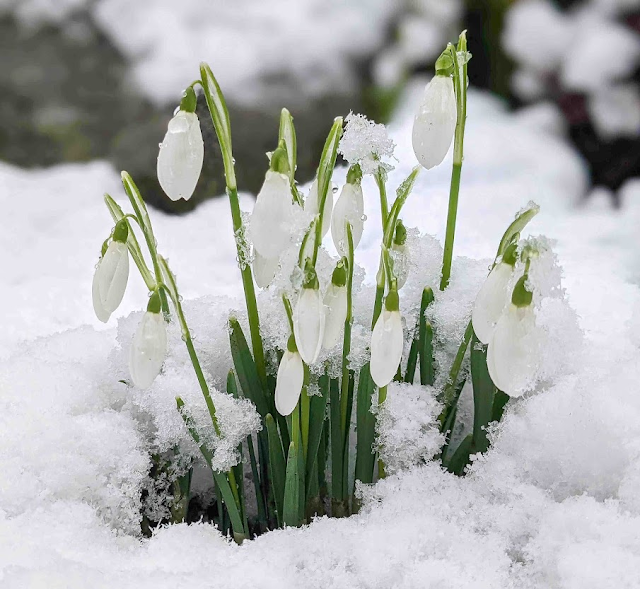
| Snowdrop buds emerging |